 |
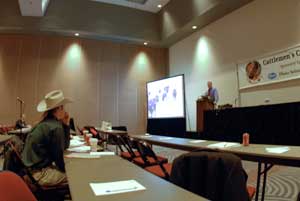
| Without a system to document management to keep cattle healthy, cattlemen’s efforts are useless, said K-State’s Mike Apley during Wednesday morning’s cattlemen’s college. |
During Wednesday’s Cattlemen’s College, Mike Apley, Kansas State University; and Mitch Blanding and Glenn Rogers, both of Pfizer Animal Health, discussed ways to reduce and treat BRD.
The best way to control BRD is to start at the ranch, Rogers said. Although he admitted BRD cases are usually minimal at the ranch, cow-calf producers can do things to ensure calves receive adequate levels of colostrum at birth, that cow health is maintained and that proper vaccination programs are implemented.
Rogers pointed out that sometimes the answers to preventing disease aren’t so obvious. “Things like using a low-birth-weight [bull] and bulls with low calving ease EPDs (expected progeny differences) can mean lower stress on calves at birth, and that can affect health later down the road.”
Blanding said combating BRD involves the “BRD Triad:” prevention, control and therapy. Blanding suggested that if producers make the right choices with animal health and animal receiving programs early, it can mean cattle will be more responsive to treatment later on.
All of these points are important in keeping cattle healthy and profit margins high, but Apely says that without a system to document their actions, their efforts are useless. Case definitions and treatment protocols are two things Apely called necessary for the success of any animal health program.
Case definitions define or characterize the symptoms that will determine whether that animal needs to be treated. Also, keeping track of when the animal is treated and with what product is another important component to success. “Too many times we put that animal in the chute and say, ‘Hmm, I think we should use this,’ ” he said.
“I have seen places floundering with their therapy; part of the reason is because they couldn’t agree on protocols. There would be huge discrepancies on whether treatment took place on weekends or weekdays and what products were to be used,” Apely said, adding that consistent protocol implantation is the only way you can measure whether your program is really working.
BRD is treatable and preventable. However, as these three individuals commented, it takes a program to see successful treatment in your herd.
— by Crystal Young
Editor’s Note: This article was written under contract or by staff of Angus Productions Inc. (API), which claims copyright to this material. It may not be published or distributed without the express permission of Angus Productions Inc. (API). To request reprint permission and guidelines, contact Shauna Rose Hermel, editor, at (816) 383-5270 or shermel@angusjournal.com.